The day after the election, I scrolled through social media as friends and family turned their feeds into battlegrounds of frustration. Many were heartbroken, outraged. Some vowed to cut ties with anyone who voted for Trump, and a few labeled his supporters as irredeemable, unintelligent, sexist bigots. I understand the anger and I’m pissed off too. I’m deeply concerned about Trump’s track record on democracy, decency, and basic human rights, and I fear what another term could mean for this country.
As a veteran, I find his disregard for (and open hostility toward) democratic principles particularly painful, to say nothing of the January 6th attack on the very foundations of our republic. Trump’s actions have consistently undermined the values I and so many others served to protect. He should be facing accountability, and in my opinion a jury, not occupying the Oval Office once again. But reducing all 74 million Americans who voted for him to simple labels overlooks a significant part of the story, a story that Sen. Bernie Sanders highlights in his post-election statement when he said, “It should come as no great surprise that a Democratic Party which has abandoned working-class people would find that the working class has abandoned them.”
There is undeniable truth to the idea that sexism and racism played a role in this election’s outcome, and for many people, the sight of yet another qualified female candidate defeated by an elderly white man who openly embodies misogynistic values is devastating. I’m not a woman, so I can’t fully understand that experience, and won’t pretend to, but I do hear the frustration from the women in my life loud and clear. Yet another moment when it seemed the highest glass ceiling might finally be shattered, only to remain solidly intact. Their feelings are real and valid and I listen to them, but I also believe if we view this loss solely through the lens of sexism and bigotry, we risk missing a broader message so many voters tried to send: For a significant number of them, this vote wasn’t about perfect ideological alignment with Donald Trump,
Polling tells us that most Americans actually support progressive policies, particularly on issues like abortion and healthcare, as we’ve seen in recent ballot initiatives across the country. Yet this election reflected profound frustration among working class Americans who feel increasingly left behind by both major parties. Where the Democratic Party once stood as a champion for working people, it now appears to many as a party aligned with coastal elites, often more focused on hot button social issues than on the bread-and-butter concerns like affordable housing and the rising cost of everyday goods. For many of these voters, supporting Trump was less about admiration and more about a visceral need for change.
Exit polls reveal the urgency of this sentiment. Over two-thirds of voters described the economy as “poor,” and the vast majority of those who described it that way backed Trump. More voters said they were worse off financially than four years ago, and eight in ten of those voters chose Trump. Inflation, in particular, loomed large with most voters saying it was a serious hardship, with nearly a quarter describing it as “severe.” Though Harris led Trump among voters who said abortion should remain legal, Trump still captured 28% of these votes too, indicating that for many voters, economic concerns took precedence over everything else. In fact, even though more voters found Trump’s views extreme compared to Harris’s, nearly 1 in 10 of those voters backed him anyway, a signal that they were seeking any perceived alternative to what they view as the status quo.
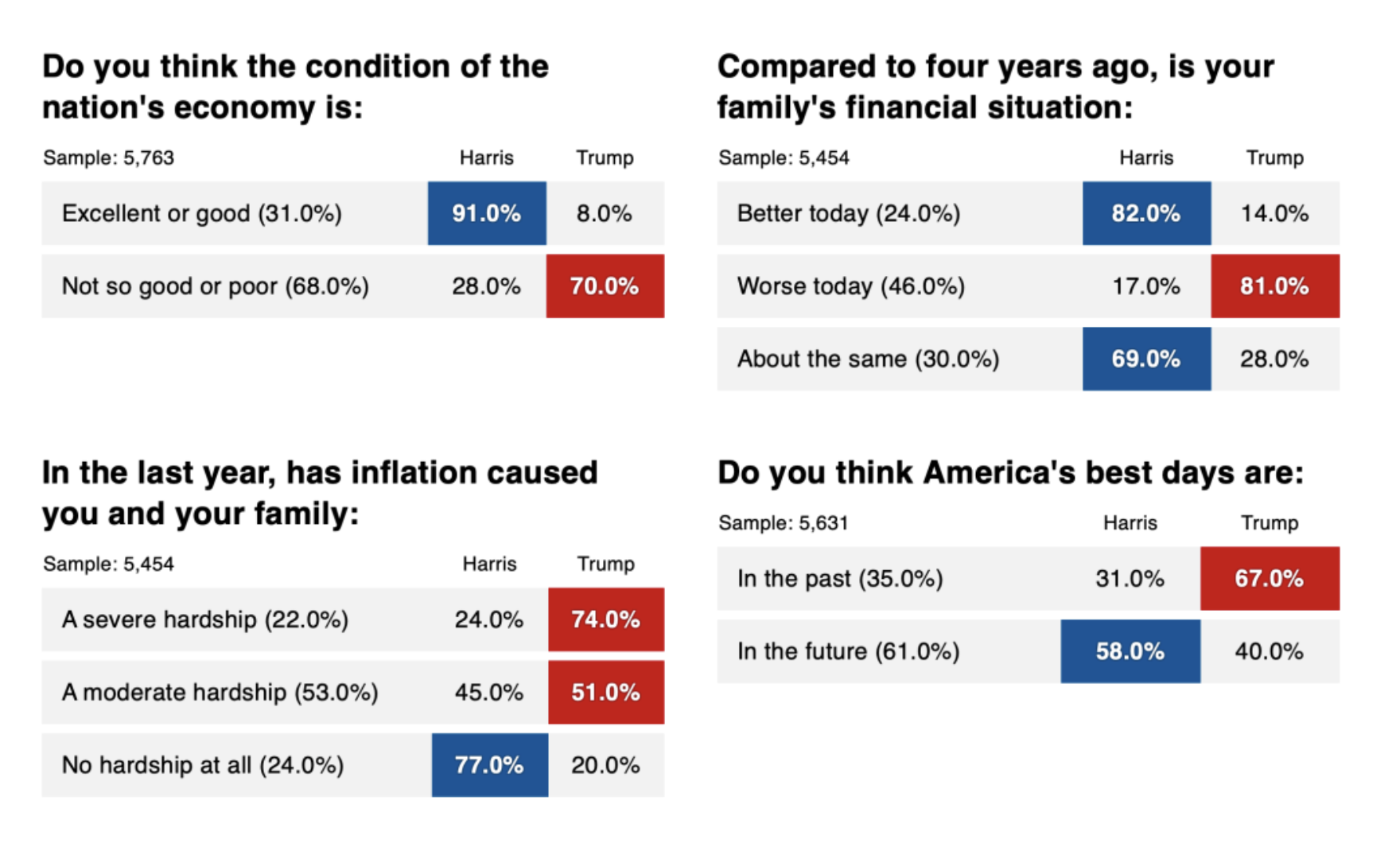
It’s no secret that economic dissatisfaction is a powerful motivator, and inflation carries a unique sting. Even as wages have risen for some and inflation has slowed over the past year, prices still remain significantly higher than before the pandemic. For many, this feels like an enduring loss. Psychologists call this “loss aversion,” the idea that people feel more pain from losing something than they feel satisfaction from gaining something equivalent. So even though wages have technically kept pace with inflation in some sectors, the erosion of purchasing power and the memory of sticker shock at grocery stores and gas stations remain deeply painful for a lot of voters.
Adding to this frustration is the sense of helplessness that inflation creates. Unlike unemployment, which hits a smaller segment of the population, higher prices affect almost everyone, and there’s not much the average person can do about it. People expect their leaders to step in and solve the problem, and when they don’t see quick results, they tend to blame whoever’s in charge, whether that blame is fair or not. So even when economic indicators begin to show signs of improvement, a lot of voters still felt let down by a system that they already didn’t trust much to begin with.
In previous elections, Democrats have carried women by wide margins. Hillary Clinton won women by 13 points in 2016, and Joe Biden by 15 in 2020. But this time, Harris managed only a 10-point lead, and Trump actually won the majority of white women. These numbers reflect something bigger than partisan fluctuations. For many people, economic survival takes priority over party loyalty, policy positions, or ideology. And folks trying to make ends meet don’t always have the time or energy to dive into policy breakdowns. They go with the candidate who seems most likely to shake up the system. Or at least throw a wrench into it.
When we dismiss all these voters as “deplorable,” “stupid,” or worse, we reinforce the same elitism that’s already pushing them away. If someone feels like they’re being talked down to, told that they’re too ignorant or dumb or misinformed to know what’s best for them, they stop listening. And that silence creates room for right-wing demagogues like Trump to step in and hijack their frustration for their own agendas.
Listening to Trump voters doesn’t mean excusing Trump. It doesn’t mean that we ignore the racism, xenophobia, or misogyny found among large parts of his base. But it does mean recognizing that a large number of Americans feel abandoned by a political and economic system they think works only for the powerful. And when people feel desperate, they’ll put their faith in anyone who promises to tear it all down.
Meanwhile, conservative groups like The Heritage Foundation aren’t just waiting in the wings. They’re laying out detailed plans like Project 2025, a full-blown blueprint to overhaul the federal government and dismantle protections, gut independent agencies, and rewrite laws to match a hard-right agenda. It proposes replacing career civil servants with loyalists, scrubbing terms like “reproductive rights” and “sexual orientation” from federal policy, restricting the press, and even banning pornography. It’s all right there in the text for anyone who wants to read it.
These aren’t vague threats. They’re open declarations. And if these plans are implemented, they’ll reshape our democracy in ways that are difficult to reverse. And if we allow fear or outrage to drown out dialogue, we risk alienating even more people and pushing them further into the arms of the very forces we’re trying to resist.
Fighting hate, bigotry, and authoritarianism is non-negotiable. But if we want to prevent history from repeating itself, we also need to understand what’s driving people’s decisions. The Democratic Party, if it wants to stop this authoritarian slide, must return to policies that offer real, visible hope to working class people: better healthcare, affordable housing, decent wages. Stuff that actually changes lives. This doesn’t happen in one election cycle, and it doesn’t happen through division. It takes uncomfortable conversations, honesty, and yes, some empathy.
We don’t need to agree with Trump voters. But if we want to change their hearts and minds, we can’t just write people off completely. We have to try to talk to them.
The path forward requires more than just opposing Trump’s agenda, although we have to do that as well, It demands some level of openness to the concerns of those who, for whatever reasons, feel like he speaks for them. If we condemn without conversation, we confirm the perception of elitism. To change their minds and win back these voters, we need to talk with them, and we need them to vote in the midterms and the next presidential election. Despite our differences, we’re all navigating this challenging time together. And to move forward, we must find a way bridge these divides, not just for our future, but for the survival of democracy itself.
Nick Allison is a former Army infantryman, a college dropout, and a writer based in Austin, Texas. He spends too much time reading about history, democracy, authoritarianism, and systems in collapse—and not enough time being optimistic about any of it. He’s not a journalist or a pundit—just a political independent, unaffiliated with any party, who still believes the Constitution is worth defending. Ever since discovering the Mac shortcut for the em dash way too late in life, he’s been abusing it—constantly—and has no plans to stop.
Also, he secretly enjoys writing his own bio in the third person because it probably makes him feel a little smarter and more important than he actually is.
Discover more from the chaos section
Subscribe to get the latest posts sent to your email.


 the chaos section